
The Anatomy of a Wedding Invitation
The moment you’ve chosen your date, booked your dream venue, and finalized your guest list, the next chapter of your wedding story begins: inviting your loved ones to join the celebration. Your wedding invitation is more than a formality. It’s the first glimpse of the magic to come. It sets the tone, builds anticipation, and whispers, ‘something wonderful is about to happen.’
Even if you’ve already picked your stationery and carefully selected the perfect stamps, you might still be wondering how to capture it all in words. What must be included? What can be left unsaid?
The truth is, invitation wording is simpler and far more flexible than you might imagine. A few timeless details are always essential: your names, your date, and the place where your “happily ever after” begins. The rest is a chance to make the moment yours, to reflect your story, your style, and the feeling you want your guests to carry with them until the big day arrives.
Let’s walk through the key pieces, line by line, so you can craft an invitation that feels as beautiful and intentional as the day itself.
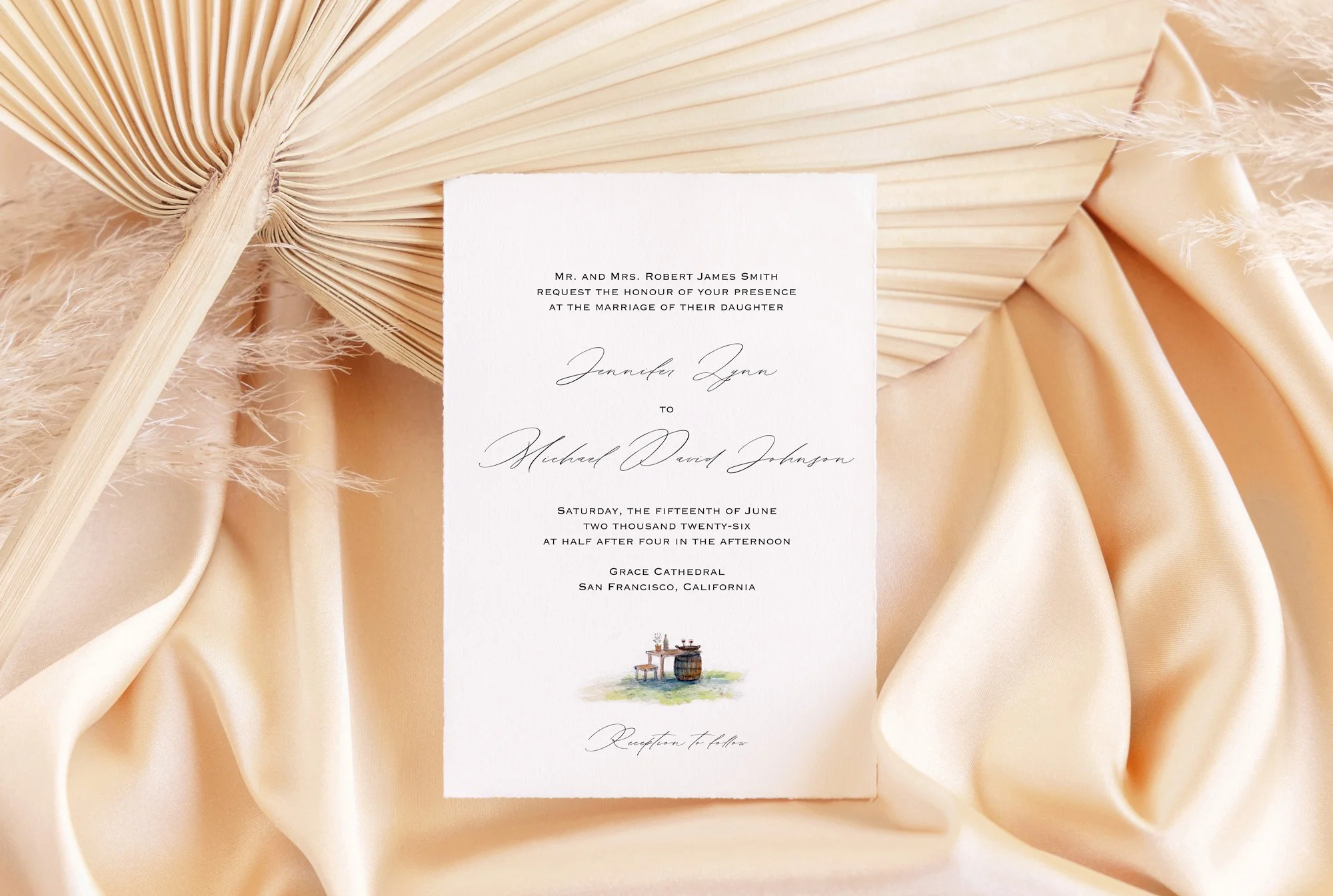
What to Include
Every wedding invitation is a little work of art—equal parts information and enchantment. Beneath the design and the poetry, though, every invitation needs a few essentials to make sure your guests know when and where your story unfolds.
The Host Line
This is where your invitation begins by acknowledging who is hosting (and traditionally, who is footing the bill). The host line usually appears right at the top, like a graceful opening to your love story.
The Request Line
Next comes the heart of the invitation—the actual ask. This is where you invite your guests to share in the joy of your day and witness the moment you say “I do.”
The Couple’s Names
The stars of the story, of course, are the two of you. Your names take center stage —the moment when the invitation becomes truly personal.
The Date and Time
This is when the magic begins. Whether it’s written out formally or kept simple and modern, this line tells guests exactly when your ceremony will take place.
The Location
Your setting is part of the fairytale too—include the venue name, along with the city and state, so guests can picture where your vows will unfold.
Reception Details
Finally, a little note about what happens after the ceremony, whether it’s cocktails under twinkle lights, dinner and dancing, or a celebration that carries on beneath the stars.
1. The Host Line:
Every tale begins with a gracious introduction. The host line is where you acknowledge those who are inviting guests to share in your special day. Traditionally, this is the couple’s parents — but in modern love stories, it can include both families, the couple themselves, or a mix of loved ones who’ve helped bring the day to life.
Married parents as hosts:
The level of formality determines how you present the parents' names. Most formal invitations include middle names, while casual versions use first names only.
Mr. and Mrs. James Edward Peterson (most formal)
Mr. and Mrs. James Peterson (formal)
Mr. and Mrs. James and Linda Peterson (formal with both first names)
James and Linda Peterson (casual)
Divorced parents as hosts:
List the mother's name on one line and the father's name on a separate line below. Don't connect them with "and" since they're no longer married.Ms. Susan Martinez
Mr. David Martinez
Both families hosting:
Traditionally, when both sets of parents are hosting, the bride's parents appear first in same-sex couples. Same-sex couples can choose based on personal preference or visual balance.
Mr. and Mrs. Thomas Reid and Mr. and Mrs. Charles Foster (formal)
Thomas and Marie Reid together with Charles and Diana Foster (casual)
Joint hosting by couple and families:
When wedding costs are shared among the couple and their families, acknowledge everyone's contribution with an inclusive opening line.
Together with their families
Together with their parents
Along with their families
Couple as hosts:
Couples hosting their own wedding can either skip the host line entirely or open with a welcoming phrase that sets a joyful tone.With joyful hearts
With greatest joy
Joyfully inviting you
With love and happiness
Deceased parent:
Honor a parent who has passed away by mentioning them in the invitation without listing them as a host.Mrs. Patricia Greene
requests the honour of your presence
at the marriage of her daughter
Margaret Anne
daughter of the late Mr. Robert Greene
2. The Request Line
This is the heart of your invitation — the moment your guests are officially welcomed into your story. The request line sets the tone for the entire celebration, and just like the opening line of a beloved fairytale, it invites your loved ones to step into your happily-ever-after.
A few things to note:
“The honour of your presence” is used when the ceremony takes place in a house of worship — a phrase that carries elegance and grace.
The British spelling of “honour” lends a more traditional, formal tone. If you choose it, pair it with “favour” on your RSVP card (“the favour of your reply”).
“The pleasure of your company” is the classic choice for ceremonies held outside of religious spaces — warm, sincere, and welcoming.
Modern couples often choose lighter language that reflects their unique style and story.
Examples:
request the honour of your presence
request the pleasure of your company
invite you to celebrate with them
would love for you to join them
3. The Couple’s Names
This is where your love takes center stage. Whether you prefer a timeless introduction or something more contemporary, the names anchor your invitation in the story of you.
Traditionally, the bride’s name appears first, followed by the groom’s. For same-sex or non-traditional pairings, list names in whichever order feels most natural or balanced.
Examples:
Jennifer Lynn to Mr. Michael David Johnson
Sarah Chen and Marcus Williams
Amelia Grace with Oliver James
Tessa Marie and Rowan Lee
Think of this as the title of your story — a declaration of two names that, from this day forward, belong together.
4. The Date and Time
Every fairytale needs a moment when the magic begins. Here’s where you tell guests when to arrive for the start of your celebration.
Formal invitations traditionally spell everything out:
“Saturday, the fifteenth of June, two thousand twenty-six, at half after four in the afternoon.”
Modern invitations often simplify this to “Saturday, June 15, 2026, 4:30 p.m.”
If you’re leaning into an ethereal or romantic tone, you might even add a poetic touch:
“as the sun sets over the garden”
“at twilight, beneath the stars”
5. The Location
Your venue is more than a place — it’s the setting where your story unfolds. Include the venue name and the city and state (no need for a full street address unless it’s a private residence).
Examples:
Grace Cathedral
San Francisco, California
The Garden Pavilion
Austin, Texas
The Willow House
Charleston, South Carolina
If you’re celebrating somewhere dreamy or outdoors, you might add a touch of imagery:
“in the meadow at Oak Haven”
“beneath the old oak trees at Riverstone Estate”
6. Reception Details
The “happily-ever-after” continues here. Let your guests know what follows the ceremony — a dinner, a dance, or perhaps a starlit garden celebration.
Examples:
Reception to follow
Dinner and dancing to follow
Feast and merriment to follow
Join us after the ceremony for cocktails, dinner, and dancing under the stars
Whether it’s a grand ballroom or a backyard gathering, this final line leaves guests with a sense of joyful anticipation — a hint that the magic is only just beginning.